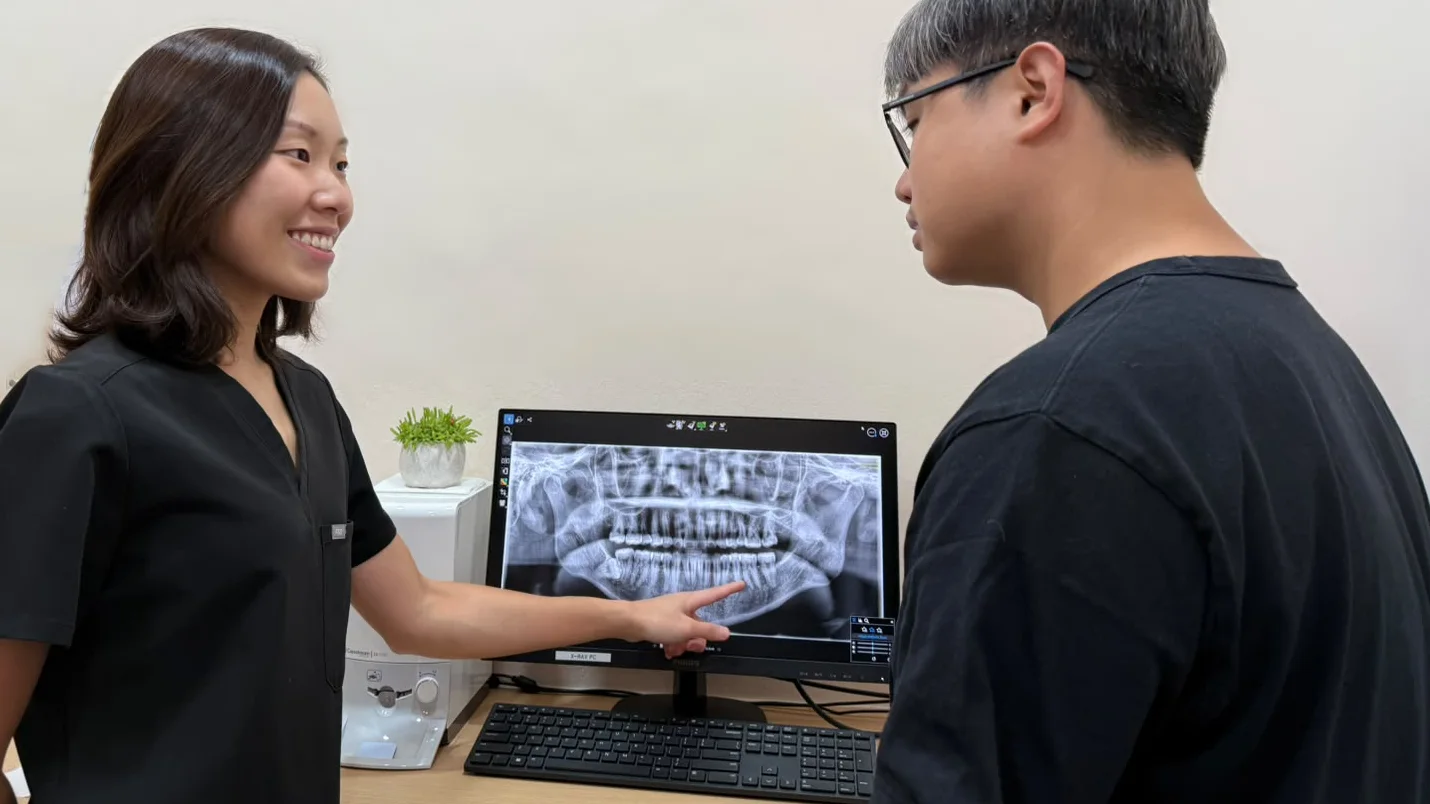
A dental X-ray shows what your dentist cannot see by looking: decay between teeth, infection at the root, bone levels and teeth still hidden under the gum. At Caring Dental, X-rays start from $25, and CHAS cardholders can claim a subsidy on up to 6 X-rays a calendar year.
Many of the problems that matter most in dentistry start out of sight. The 2019 National Adult Oral Health Survey found that 34.8% of Singapore adults had untreated tooth decay, and early decay between the teeth or under an old filling often causes no pain and cannot be spotted in the mirror. An X-ray lets your dentist find it while it is still a small repair.
This guide explains the main types of dental X-ray, what each one is for, how safe they are, and what they cost.
What a dental X-ray can find
Your dentist can see the surfaces of your teeth and gums during an examination. An X-ray shows the parts in between and underneath, including:
- Decay between teeth, or under an existing filling or crown
- Infection or an abscess at the tip of a root
- Bone loss around the teeth from gum disease
- Wisdom teeth or other teeth still under the gum, and the angle they are growing at
- Certain cracks, damaged roots, or the result of a past injury
- The space and bone available before an implant or braces
Why it matters at a check-up
Gum disease is very common: the same survey found that 77.6% of adults had some form of it. Bone loss from gum disease happens slowly and often without any symptoms, and an X-ray is how it is measured and tracked over time. That is why your dentist may suggest X-rays every so often at a routine check-up, even when nothing hurts.
The main types of dental X-ray
Caring Dental offers digital dental X-rays at all four clinics, with images ready on screen during your visit so your dentist can talk you through them.
Bitewing
A small X-ray that shows the crowns of your upper and lower back teeth together. It is the usual way to check for decay between the teeth and around fillings. You hold a small tab between your teeth for a moment.
Periapical
A small X-ray that shows one or two whole teeth, from the biting surface down to the tip of the root. It is used to look for infection at the root, before a root canal, or to check a tooth that is causing pain.
Panoramic (OPG)
An orthopantomogram, usually called an OPG, captures all your teeth, both jaws and the surrounding bone in one wide image. You stand still for a few seconds while the machine moves around your head. An OPG is commonly needed before wisdom tooth surgery, implants or braces, because it shows how the teeth and roots sit in relation to the jaw and nerves.
Are dental X-rays safe?
A dental X-ray uses a very small dose of radiation, and digital X-rays need less than traditional film. Some simple steps keep the dose as low as possible:
- X-rays only when they help. Your dentist takes an X-ray when it will change a diagnosis or a treatment plan, not as a matter of routine at every visit.
- The right X-ray for the question. A small X-ray of one area is used when that is all that is needed.
- Licensed equipment. In Singapore, X-ray equipment must be licensed by the National Environment Agency under the Radiation Protection Act 2007.
- Protective aprons. These are used as an added precaution.
If you are pregnant or think you might be, tell your dentist before any X-ray. Routine X-rays may be postponed, and if you need urgent treatment your dentist will discuss whether one is needed.
What dental X-rays cost
At Caring Dental, X-rays start from $25. A panoramic OPG costs more than a small bitewing or periapical X-ray. When an X-ray is taken as part of a treatment such as wisdom tooth surgery, it is usually included in the overall treatment quote.
For a wider reference, the Ministry of Health published fee benchmarks for CHAS dental clinics in 2025: $16 to $33 for a small intraoral X-ray (periapical, bitewing or occlusal) and $65 to $104 for a panoramic X-ray. These are reference ranges, not fixed prices.
How CHAS lowers the cost
Caring Dental is a CHAS dental clinic, and X-rays are one of the procedures CHAS subsidises. The maximum subsidy per X-ray, according to the Ministry of Health (2025), is:
| Card | Subsidy per X-ray |
|---|---|
| CHAS Orange | up to $7.50 |
| CHAS Blue | up to $11 |
| Merdeka Generation | up to $16 |
| Pioneer Generation | up to $21 |
You can claim for up to 6 X-rays a calendar year. The subsidy is taken off at the counter, so bring a valid card to your appointment. Our CHAS dental subsidies guide explains who qualifies for each card.
Getting a dental X-ray at Caring Dental
X-rays are available at all four Caring Dental clinics, open seven days a week (closed on public holidays), with evening hours on weekdays.
- Punggol: Blk 665A Punggol Drive #01-02 · 6481 6833
- Sengkang: Blk 473A Fernvale Street #01-01 · 6634 6689
- Anchorvale: 326A Anchorvale Road #01-258 · 6352 2282
- Woodlands: 136 Marsiling Road #01-2170 · 6200 3200
Most X-rays are taken as part of a check-up or a visit about a specific problem. Book an appointment at the clinic nearest you, and bring your CHAS, Merdeka Generation or Pioneer Generation card if you have one.
Need Dental Care?
Book an appointment at any of our 4 clinics. Open 7 days a week.
Request Call Back